Two suburbs in one
Meadowbank changed shape over the last two decades. Along the river and through the Shepherds Bay area, former industrial land became a dense precinct of mid and high-rise apartment buildings, mostly from the 2000s onward, with lifts, basement parking, building managers and formal renovation guidelines.
A short walk inland, the older Meadowbank is still there: three-storey face-brick walk-ups from the 1960s and 1970s on the streets around the station, a handful of post-war houses, and the familiar collection of 1990s villa complexes.
Almost everything we do here is an apartment bathroom. Which kind of apartment decides the entire job.
Newer apartments: a lighter scope, more process
A bathroom in a building from the 2000s or 2010s usually has a workable layout, a membrane that may still be sound, a functioning exhaust, and fittings that are simply dated or cheap rather than failed. The typical scope is fittings, glass, joinery, tiling and lighting — sometimes without touching the floor at all.
That changes the technical risk and shifts the effort onto process:
- Written renovation guidelines, which the building will give you on request and which are usually specific about hours, protection and waste
- A nominated service lift, protected and booked in advance in time slots
- A loading dock with its own rules about vehicle size and duration
- A building manager who wants a program, insurance certificates and trade details before anyone starts
- Narrower permitted hours than an older block, because more residents are home during the day
None of that is an obstacle. A well-run building with clear rules is far easier to work in than an old block where nobody can tell you what is allowed.
The judgement call in these apartments is whether the existing membrane stays. If nothing moves and the room is dry, a lighter scope is legitimate. As soon as a floor waste shifts, a hob comes out or a wall is opened, the membrane is disturbed and it is replaced and documented properly — see waterproofing and tiling.
Older walk-ups: the full job
The 1960s and 1970s blocks near the station are the same building type found right across the district: concrete slab, 40 to 70 mm sand-and-cement bed, waste pipes cast into it, a stack shared with the flats above and below, a bath with a shower over it, tiles to about 1,500 mm, a high louvre window, and a fan that vents into the ceiling space or does not exist.
These get taken back to slab. New falls, new membrane, hobless shower, wall-hung vanity, storage in the wall, real extraction. The gain is enormous, and so is the noise on demolition days. The small bathroom page sets out the layout logic.
The laundry question, which is bigger here than elsewhere
Meadowbank's apartment stock produces more laundry enquiries than any other part of the district, for two different reasons.
In the older walk-ups, the laundry is frequently a machine in the bathroom, a cupboard in the hallway, or a slab on an enclosed balcony with a tap and a tub. The balcony version is the one that needs care: the slab and its membrane are almost certainly common property, and the enclosure may or may not have been approved when it was built.
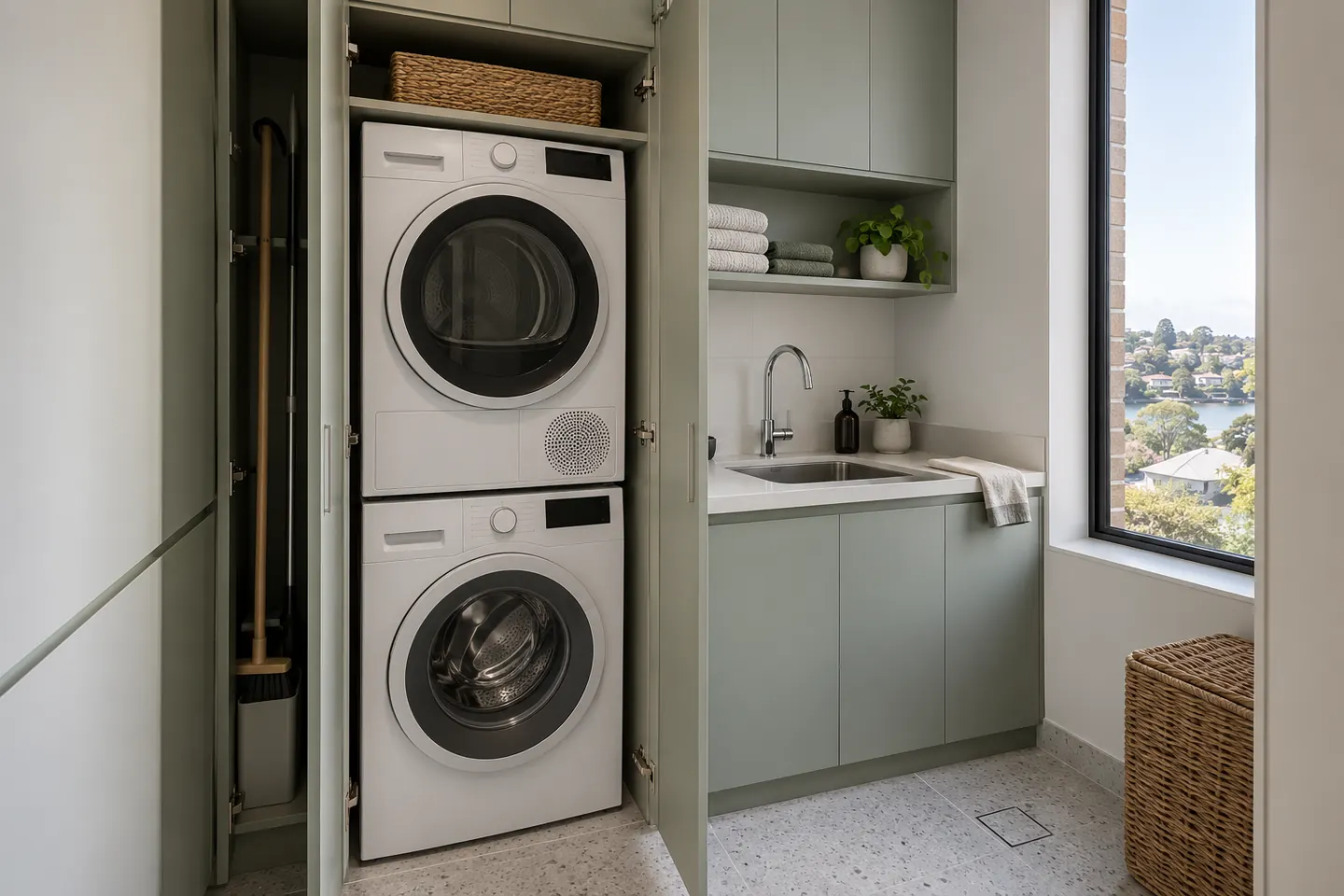
In the newer apartments, the laundry is usually a purpose-built European cupboard that was sized for the machines available when the building went up. Fitting today's larger front loaders into it, or stacking a heat pump dryer above one, is a dimensional puzzle, and depth is the number that catches people out rather than width.
The laundry renovations page covers both, including why a vented dryer in a closed cupboard is a mould problem waiting to happen.
A river-facing detail
Apartments looking over the Parramatta River get more humidity and, on the exposed elevations, more weather. Two practical consequences: extraction matters even more than usual, because the outside air is often not dry enough to help; and in windows and doors on exposed faces, the hardware and finishes take a harder life than they would inland. For bathroom fittings, choosing a quality finish over a budget chrome plating is a reasonable call in this pocket.
Investors, because there are many here
A high proportion of Meadowbank apartments are investor-owned, and the renovation brief for a rental is genuinely different: durable, easy to clean, neutral, and programmed into a vacancy window rather than open-ended. The critical point is that owners corporation approval has to be obtained before the tenancy ends, not after — see the rental bathroom page and the strata renovation rules guide.
Approvals in a strata building, in short
Bathroom work disturbs waterproofing, and the membrane and slab are usually common property, so the owners corporation's consent is generally needed and many buildings want a by-law recording who maintains the new membrane. Your by-laws and strata manager are the authority for your building. We assemble the application pack — scope, membrane specification, licences, insurances, hours, protection and waste route — in one document set.
Costs
The cost tiers give planning figures for both building types. A measure turns a tier into a written, itemised price.
Nearby
We also work in West Ryde, Gladesville, Denistone, Melrose Park and Ryde.
Renovation work is carried out in partnership with Coastal Renovation Group, a licensed NSW builder — licence and insurance details are provided on request.
Call 02 5563 0307 or tell us the building's age and whether it has a lift.
Nearby suburbs
Questions people ask before they commit
What is different about renovating in a newer apartment tower?
The paperwork is more formal and the building is better organised. Expect written renovation guidelines, a nominated service lift with bookable time slots, a loading dock, set delivery and work hours, and a building manager who will want a program. That is easier to work with than an old block with no guidelines, even though it feels like more hoops.
Is the membrane in a 2010s apartment worth keeping?
Sometimes, and it is assessed rather than assumed. If the room is watertight, the falls are correct and nothing is being moved, a lighter scope that keeps the existing membrane can be appropriate. The moment a floor waste moves, a hob is removed or a wall is opened, the membrane is being disturbed and it is replaced and recertified.
Can I renovate a balcony laundry?
Usually only with the owners corporation involved, because a balcony slab and its membrane are almost always common property. If the balcony was enclosed at some point in the building's history, it is also worth establishing whether that enclosure was approved before spending money finishing it.
Do the towers allow noisy work?
Within defined hours, yes, and those hours are typically narrower than in an older walk-up. Newer buildings also have more residents working from home, so a building manager may ask for notice to specific neighbours. It is all workable; it just has to be in the program from the start.
What does a bathroom renovation cost in Meadowbank?
The two building types sit in different places. A lighter refresh in a newer apartment where the layout and membrane stay is generally a smaller scope than a full strip-out in a 1960s walk-up. The cost page explains the tiers, and a measure gives a written price for your room.