Who this page is for
Ryde has a large investor-owned unit market, and most of it is concentrated in a few recognisable pockets: the older walk-ups around West Ryde and Meadowbank station, the newer apartment stock along the Meadowbank and Macquarie Park corridors, and the student-heavy blocks close to the university and the business park. Owners are often not local, sometimes not in Sydney, and occasionally not in Australia.
That changes what a good service looks like. It has to be specific in writing, defined in time, and manageable without the owner standing in the room.
The rental brief, plainly
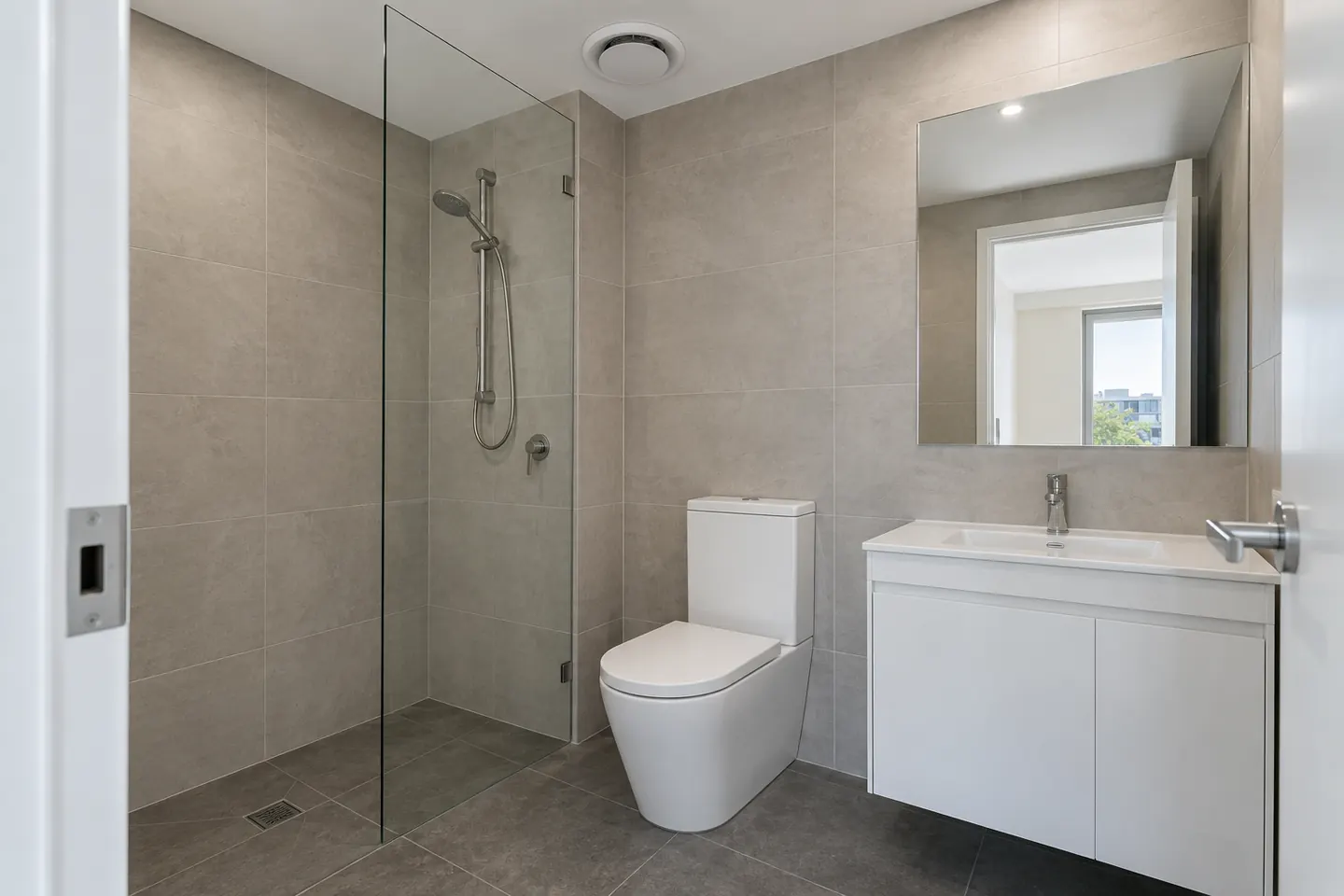
Durable beats fashionable. A rental bathroom is cleaned by different people with different products every couple of years. The specification leans towards a quality porcelain floor and wall tile, a solid-surface or porcelain top rather than anything that swells, a robust toilet with commonly available parts, and tapware from a range whose cartridges will still be sold in ten years.
Easy to clean, with fewer traps. Wall-hung or wall-faced pans, a single fixed glass panel instead of a framed enclosure, full-height tiling with no painted band above it, and minimal silicone lines. Less to scrub, less to report as mouldy, fewer condition-report arguments.
Neutral, not bland. A plain palette photographs well for listings and appeals across a broad tenant pool. One point of interest — a floor tile with some texture, a decent mirror, a tapware finish — is enough.
Extraction that works. More rental mould complaints come from a poor fan than from anything a tenant does. A correctly sized fan on a run-on timer, ducted to outside air where the building allows, is the cheapest tenancy-dispute insurance available.
Nothing that needs explaining. If a fitting requires an instruction sheet, it is wrong for a rental.
The program, and why approval comes first
The temptation with an investment unit is to book the trades for the vacancy window and sort the paperwork as you go. In a strata building that is how a two-week vacancy turns into ten.
The sensible order is:
- Measure and quote while the current tenancy is running.
- Lodge the owners corporation application and get approval, which depends on your building's meeting schedule — this is the long pole and it is entirely outside anyone's control but the committee's.
- Lock selections and order materials, so tile lead times run in parallel with the approval rather than after it.
- Give notice properly and align the vacancy with the build start.
- Build, with the membrane cure as a fixed point in the middle.
- Hand over with documents, photograph the finished room for the listing and the condition report.
Our process page covers each stage in detail, and the strata rules guide explains what an owners corporation generally asks for.
Older walk-ups versus newer apartments
A 1960s or 1970s walk-up is the full job: mortar bed off, slab exposed, falls corrected, new membrane, new everything. It is also where the pre-1990 asbestos test applies, and where stair access and restricted noisy-work hours affect the program. The compensation is that these bathrooms improve dramatically, because the starting point is so poor.
A 1990s to 2010s apartment is usually a lighter scope: the layout works, the membrane may be intact, and the job is often fittings, glass, joinery, tiling and extraction rather than structural. Buildings of this vintage frequently have detailed renovation guidelines, a designated lift and set delivery times, all of which are easier to work with than the ad hoc arrangements in an old block.
Both are quoted the same way: one itemised written price, with allowances stated.
Landlord obligations worth knowing about
This is general information, not legal advice, and the current requirements sit with NSW Fair Trading and the residential tenancies legislation — but two points come up constantly.
Repairs are not optional. A bathroom that leaks, a fan that does not work or a shower that cannot be used safely is a repair matter, and letting it run is usually more expensive than fixing it, both in the eventual repair and in the tenancy relationship.
Water efficiency matters if you pass on water usage. Separate metering and specified water-efficiency requirements apply before water usage charges can be passed to a tenant. Fitting efficient tapware, showerheads and a dual-flush toilet during a renovation is the easy moment to deal with it.
Asbestos in investor stock
Pre-1990 buildings get a test before demolition, and in a rental that matters twice: once for the legal obligation, and once because a tenant or a neighbour who learns that sheeting was cut without testing will remember it. Removal is separately licensed work with a clearance before other trades return.
What you get in writing
- An itemised quote with fittings named, allowances stated and site costs shown
- A scope your strata manager or committee can read without translation
- The waterproofing documentation, the electrical certificate and any asbestos test result
- Progress tied to completed stages, with a deposit of no more than the NSW maximum of 10 per cent
- Photographs at handover
For planning figures see the cost page, which also explains what shifts a job between tiers. If the unit is small, the small bathroom page is the more useful read on layout.
Renovation work is carried out in partnership with Coastal Renovation Group, a licensed NSW builder. Licence and insurance details are provided on request.
Call 02 5563 0307 or send the address type, building age and access details.
Related work
| Full Bathroom Renovations | Main bathrooms stripped back to slab or frame and rebuilt, with the falls, the riser and the strata paperwork sorted before demolition day. |
|---|---|
| Ensuite Renovations | Tight ensuites reworked, and new ones found inside a robe or a hallway cupboard where the plumbing can reasonably reach. |
| Small Bathroom Renovations | The standard walk-up bathroom — bath under a shower, one small window, no storage — replanned to feel twice the size it measures. |
| Accessible Bathrooms | Step-free showers, blocking for grab rails and turning space, planned for people who intend to stay in the home they have. |
| Laundry Renovations | Internal laundries, balcony laundries and cupboard European laundries, sized around the machines people actually buy. |
| Waterproofing & Tiling | Membrane over old concrete, set-outs that land whole tiles at the visible edges, and a certificate your owners corporation can file. |
Questions people ask before they commit
How long will the unit be off the rental market?
For a bathroom-only job, plan on four to six weeks of site work once approvals and materials are in place, and add the owners corporation approval time before that. Because the membrane cure and tile deliveries are fixed, the way to compress the total is to have approval and selections finished before the tenant moves out, not to rush the build.
Can the work happen while a tenant is living there?
It is possible where there is a second bathroom, and it is rarely a good idea where there is not. A single-bathroom unit without a working bathroom for a month is not reasonably habitable, and any rent reduction or relocation needs to be agreed with the tenant in writing. Between tenancies is simpler for everyone.
Do I get the same paperwork as an owner-occupier?
Yes, and you should keep all of it. An itemised quote, the waterproofing documentation, the electrical certificate, the asbestos test result where one was required and the owners corporation approval together make up the record you will want at sale, at insurance renewal, and if a tenant ever reports a leak.
What is worth spending money on in a rental, and what is not?
Spend on the things that fail and cause claims: waterproofing, falls, extraction, glass and tapware quality. Save on the things that are only taste: keep the palette plain, the tile format standard and the joinery simple. A hard-wearing neutral bathroom lets well and photographs well; a fashionable one dates before the depreciation schedule does.
Are renovations tax deductible?
The treatment of repairs, capital works and depreciating assets differs, and it depends on your circumstances. That is a question for your accountant or a quantity surveyor, not for us. What we can do is provide an itemised quote and invoice that separates the work clearly enough for them to use.