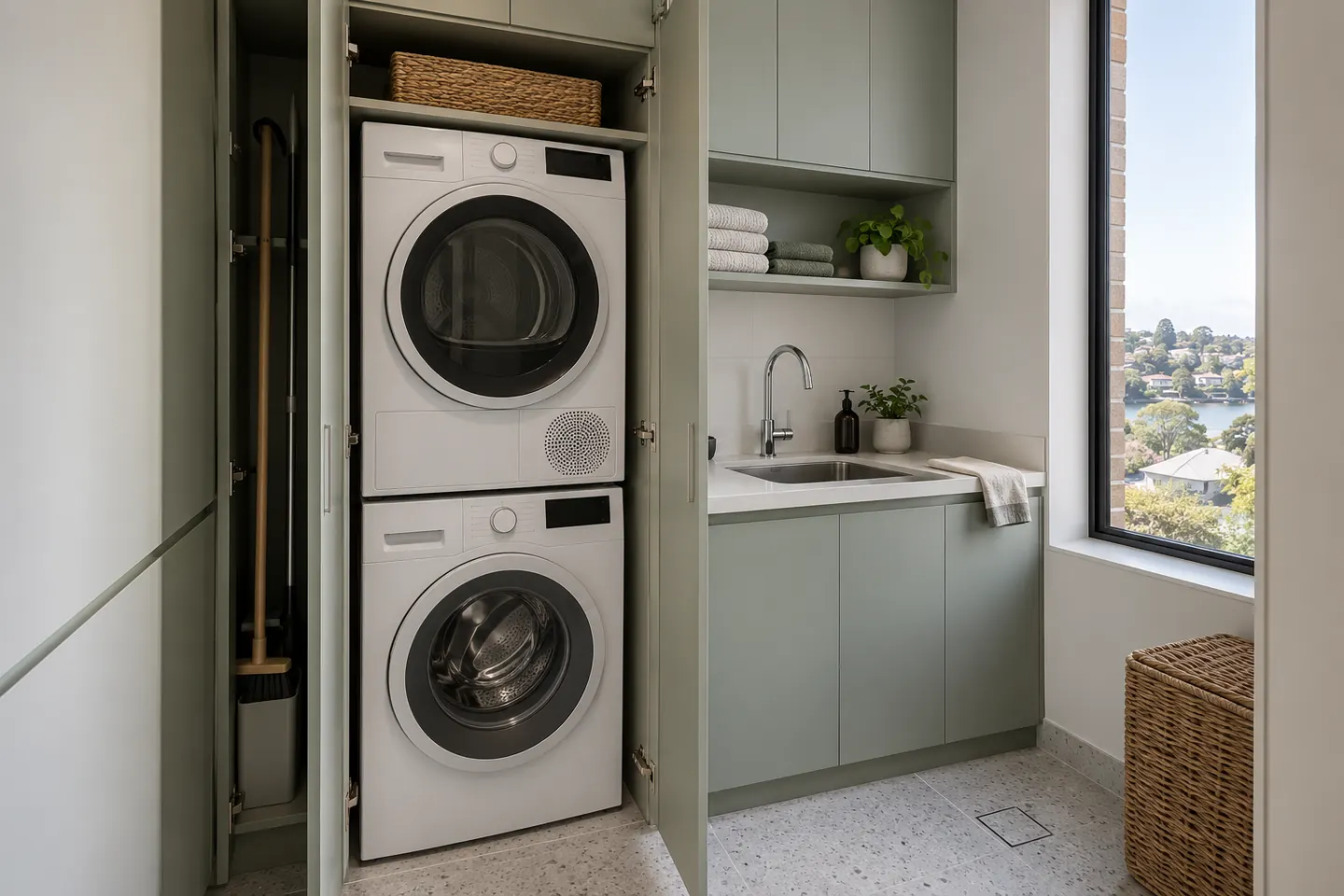
Four laundries, four different problems
The cupboard laundry. A door in the hallway or kitchen with a machine behind it, a tap set and a floor waste if you are lucky. Problems: not enough depth for a modern front loader, no bench, no ventilation, and a door that has to clear the machine door.
The bathroom laundry. A machine wedged beside the vanity or under a bench, sometimes with the taps behind it and the hose over the bath. Problems: waterproofing that was never designed for a machine, no bench to fold on, and two humidity sources sharing one tired fan.
The balcony laundry. Common in blocks from the late 1960s onward — a small concrete slab off the kitchen with a tap and a tub, later enclosed with aluminium louvres. Problems: the enclosure changed the ventilation, the waterproofing under the slab is often original and failing, and enclosing a balcony may itself have needed owners corporation approval.
The rear lean-to laundry in a post-war house. A tub, a concrete floor, a copper-era layout, a door to the backyard and frequently the toilet next door. Problems: no insulation, no storage, sheeting that needs testing for asbestos, and a floor that falls the wrong way.
Designing a laundry around the machine, not the cabinet
Laundries fail on dimensions more than on style. The sequence that avoids that is unglamorous:
- Choose the machines first, or at least their maximum size, and get the real specification sheet. Depth including hoses and the door swing is the number that decides everything.
- Decide stacked or side by side. Stacking frees a whole bay for a tub or storage but puts the dryer door high. Side by side gives a continuous bench above, which is where folding actually happens.
- Work out where the moisture goes before choosing a dryer. A vented dryer in a closed cupboard pushes warm, wet air into the room. Condenser and heat pump dryers avoid that.
- Then draw the joinery. Bench height to suit the user, a shallow cupboard for the things that go in the wash, a tall narrow slot for the ironing board and mop, and a hook for the basket.
Waterproofing, which laundries routinely lack
A laundry is a wet area. Hoses split, seals perish, and a machine that walks during a spin cycle can pull a hose off entirely. In an upstairs unit the consequence lands on somebody else's ceiling.
What that means in practice: waterproofing to the floor and up the walls behind and beside the machine, a floor waste where one can be provided, a set of lever isolation taps that are reachable without moving the machine, and a braided hose set rather than the twenty-year-old rubber ones. Where a laundry sits inside or beside the bathroom, the wet-area membrane is detailed as one continuous system. More on membranes and detailing on the waterproofing and tiling page.
Balcony laundries and enclosed balconies
If your machine sits on an enclosed balcony, two things are worth knowing. First, the balcony slab and its membrane are almost certainly common property, so any work that disturbs them involves the owners corporation. Second, if the balcony was enclosed at some point in the building's history, the enclosure itself may or may not have been approved — worth establishing before you spend money finishing it beautifully.
Where the balcony laundry stays, the practical upgrades are a properly graded and waterproofed floor, a weather-tolerant cabinet material rather than ordinary board, and an enclosure that still lets air move.
Combining the laundry into a bigger bathroom
In post-war houses around Denistone, Eastwood and West Ryde, the bathroom, separate toilet and rear laundry often sit in a row along the back of the house. Taking the whole strip and re-planning it — one properly sized bathroom, a European laundry in a cupboard, the toilet inside the bathroom rather than outside it — is the change that makes those houses feel modern. It is usually done as part of a full bathroom renovation rather than as a standalone laundry job.
Where the laundry is being relocated to a garage, allow for a hot and cold supply, a waste with fall, a dedicated circuit and a sensible run from the house in the rain. It is not always the saving it first appears to be.
Storage that earns its place
- A deep drawer rather than a cupboard for detergents, because you can see the back of it
- A shallow bench return for sorting, even 400 mm of it
- Hanging space for the things that cannot go in the dryer — a rail under the bench return, or a pull-out rod
- A broom slot 200 mm wide and full height, which stops the mop living in the shower
- A laundry bowl or deep basin if you soak and hand-wash; a plain cabinet if you do not, because an unused tub wastes a whole bay
Next
For planning figures, see the cost page — laundries generally sit in the lower tier unless they are part of a bathroom job. The process page explains the running order, and if you are in a strata building, the strata rules guide explains why a laundry with a floor waste is treated as seriously as a bathroom.
Renovation work is carried out in partnership with Coastal Renovation Group, a licensed NSW builder. Licence and insurance details are provided on request.
Call 02 5563 0307 or send the laundry details.
Related work
| Full Bathroom Renovations | Main bathrooms stripped back to slab or frame and rebuilt, with the falls, the riser and the strata paperwork sorted before demolition day. |
|---|---|
| Ensuite Renovations | Tight ensuites reworked, and new ones found inside a robe or a hallway cupboard where the plumbing can reasonably reach. |
| Small Bathroom Renovations | The standard walk-up bathroom — bath under a shower, one small window, no storage — replanned to feel twice the size it measures. |
| Accessible Bathrooms | Step-free showers, blocking for grab rails and turning space, planned for people who intend to stay in the home they have. |
| Waterproofing & Tiling | Membrane over old concrete, set-outs that land whole tiles at the visible edges, and a certificate your owners corporation can file. |
| Rental Bathroom Renovations | Investor bathrooms in units near the university and the business park: hard-wearing, quick to turn around, priced as a whole. |
Questions people ask before they commit
How much space does a European laundry cupboard need?
Enough depth for the machine plus its hoses and the door, which in practice means around 650 to 700 mm of internal depth for a standard front loader. Width depends on whether the machines sit side by side or stack. The measurement that catches people out is depth, not width, so we measure the actual machine rather than trusting a brochure.
Can a washing machine be moved to a different part of the unit?
Sometimes, within limits. It needs a cold water supply, a waste with fall, power on an appropriate circuit and, for a dryer, somewhere for the moisture to go. In a strata building the waste is the hard part, because it has to reach an existing stack. Moving it a metre or two along the same wall is often fine; moving it across the flat usually is not.
Is a washer-dryer combination worth it in a small laundry?
It saves a lot of space and suits a household that does not run loads back to back, because the drying cycle is slow. If you wash daily, separate machines stacked in a tall cupboard usually serve better. It is a lifestyle decision more than a plumbing one.
Can the laundry share the bathroom?
Very commonly, and in many Ryde units it already does. A machine under a bench beside the vanity, with the trough function built into the laundry bowl or omitted in favour of a deep basin, works well. The main requirements are proper waterproofing under and behind the machine and enough extraction for two moisture sources in one room.
What about drying clothes in a unit with no outdoor space?
A condenser or heat pump dryer avoids venting moisture into the flat, which a vented dryer in a closed cupboard will do. If clothes are dried on a rack indoors, the room needs real extraction — indoor drying is one of the biggest hidden causes of mould in older units.